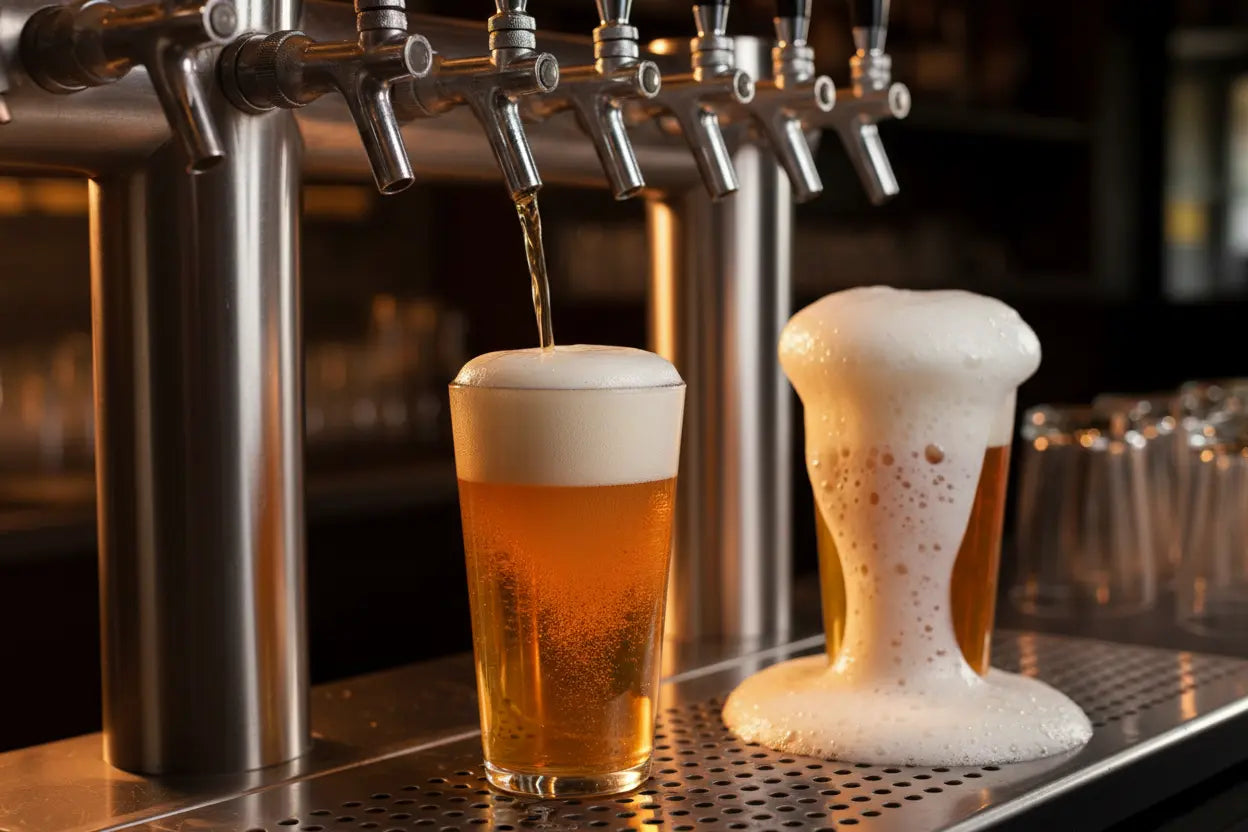
Foamy draft beer almost always comes down to one of four things: pressure that is set too high or too low for the beer style, a beer line that is too short or the wrong diameter, dirty lines or worn parts, or beer that is warmer than 38°F. Fix the pressure and line balance first (that clears most cases in one visit), then check cleanliness and temperature if the foam keeps coming back. Below is how to find which one is causing it and the exact part that fixes it.
In this article
- What causes foamy draft beer?
- What is the right CO2 pressure for a foam-free pour?
- Is my beer line too short or the wrong size?
- Could a bad FOB (foam detector) be the problem?
- Why does temperature control matter on long draw systems?
- How often should I clean lines and parts to stop foam?
- FAQ
What causes foamy draft beer?
Six things cause the vast majority of foamy pours, and they usually stack, so more than one is often true at the same time:
- Pressure too high or too low. Excess CO2 pressure forces gas back out of the beer at the faucet. Pressure that is too low lets dissolved CO2 come out of solution as the beer travels, which looks the same at the glass.
- Beer line too short, too long, or the wrong diameter for the run. The line is what balances the keg pressure down to a calm pour at the faucet. Get the length or bore wrong and the system is out of balance no matter what the regulator says.
- Beer warmer than 36 to 38°F. Warm beer releases CO2 faster and less predictably, which shows up as foam even at correct pressure.
- Dirty lines, faucets, or couplers. Beer stone and biofilm buildup give CO2 bubbles a rough surface to nucleate on, called foaming, even in an otherwise correctly balanced system.
- A failing FOB (foam on beer detector). A stuck or worn FOB on a long draw or remote system can let air or foam through when a keg runs low, and a bad one can add turbulence even mid-keg.
- Rough pouring technique. Pouring too fast, at the wrong angle, or into a warm or wet glass churns beer that would otherwise pour clean.

A dual-gauge regulator lets you see tank pressure and serving pressure at a glance, the fastest way to confirm pressure is not the problem.
What is the right CO2 pressure for a foam-free pour?
Most draft beer serves clean between 10 and 14 PSI at 36 to 38°F, with the exact number set by the beer style and how far the beer travels to the faucet. Start with the style, then fine-tune from there.
| Beer style | Typical serving PSI | Serving temp | Notes |
|---|---|---|---|
| Standard ales and lagers | 10 to 14 PSI | 36 to 38°F | Most common bar setup |
| Nitro stouts | 28 to 32 PSI (nitro/CO2 blend) | 36 to 38°F | Roughly 25% CO2 to 75% N2 blend, and a restrictor plate faucet |
| Highly carbonated German styles | 14 to 16 PSI | 36 to 38°F | Higher CO2 share on a blended gas system |
| Long draw (25+ feet to the tower) | Style PSI plus line resistance | 36 to 38°F, glycol-cooled | Needs a secondary regulator and longer, smaller-bore line to balance |
Change one variable at a time. Adjust pressure, pour a full glass, and wait a few minutes before adjusting again, CO2 takes time to re-equalize in the line after any change.
Is my beer line too short or the wrong size?
Beer line resistance is what actually balances the system, not just the regulator. Standard 3/16" ID vinyl line creates roughly 2 to 3 PSI of resistance per foot at serving temperature, so a system serving at 12 PSI generally needs about 4 to 5 feet of 3/16" line between the coupler and faucet to pour calm. A line that is too short leaves excess pressure unresolved, which shows up as foam the moment beer hits the glass.
This is also why a keg that pours fine at the bar next door can foam constantly at yours, line length, not just pressure, is doing real work in the system. If a single faucet foams while the others on the same regulator pour clean, check that faucet's line length and routing before touching pressure again.

Sold by the foot, so you can correct a line that is too short or swap out a run without buying a full roll.
Could a bad FOB (foam detector) be the problem?
A FOB, short for "foam on beer" detector, sits in the line on long draw or remote systems and stops beer flow when a keg runs empty, so the line does not fill with foam and air while nobody notices. The float inside rises with normal beer flow and drops when the keg kicks, closing the valve.
A worn or stuck FOB causes two different symptoms depending on how it fails. If it sticks closed, you get little or no flow at all. If it sticks open or the seal wears out, air and foam pass straight through even with a fresh keg on the line, which reads exactly like a pressure or line problem until you isolate the FOB and test it on its own. If you run a long draw or multi-keg system and only some lines foam, check the FOB on those lines before re-balancing the whole system.

A direct swap for a worn foam detector on long draw and remote systems, so foam and air stop passing through after a keg change.
Put a dollar value on foam waste
If kicked kegs are the repeat problem, run the draft beer profit margin calculator before ordering parts. It shows how many sellable pints disappear at each waste percentage and helps decide when a FOB detector starts paying for itself.
Calculate foam waste profit →Why does temperature control matter on long draw systems?
Beer above 38°F releases dissolved CO2 faster than it can escape cleanly through the faucet, so it comes out as foam instead of staying in solution until the glass. This gets harder to control the further beer travels from the walk-in to the tap, which is exactly why long draw systems (25 feet or more to the tower) run glycol-cooled trunk lines instead of relying on ambient temperature alone.
A glycol pump circulates chilled glycol alongside the beer line inside an insulated trunk line, holding the beer at serving temperature for the entire run instead of letting it warm up in the last 10 to 15 feet before the tower. If foam only shows up on the towers furthest from the cooler, or gets worse later in a shift as ambient heat builds up, temperature control along the line, not pressure, is usually the real cause.

Keeps beer at serving temperature over long trunk line runs, so the last tower in the building pours as clean as the first.
How often should I clean lines and parts to stop foam?
Beer stone and biofilm buildup inside a dirty line give CO2 a rough surface to break out of solution on, so foam can persist even after pressure, line length, and temperature are all correct. Run a caustic clean through the lines every two weeks and an acid clean every six months, and never stretch the caustic clean past six weeks. Clean the coupler and faucet at the same time, since buildup at either end causes the same turbulence a dirty line does. See our full walkthrough in How to Clean Beer Lines for the step-by-step process.
Frequently asked questions
Why is my draft beer all foam all of a sudden?
A sudden change usually means pressure, temperature, or a keg change disturbed the balance, not a slow buildup issue like dirty lines. Check that the regulator was not bumped, that the walk-in or kegerator is still holding 36 to 38°F, and that the new keg's coupler seated fully. Those three catch most "it was fine yesterday" cases.
What PSI stops beer from foaming?
Most standard ales and lagers pour clean between 10 and 14 PSI at 36 to 38°F, but the correct number depends on the beer style and how far the line runs to the faucet. Nitro stouts and highly carbonated styles need different pressure and gas blends, and long draw systems need extra PSI to overcome line resistance.
How do I know if my FOB (foam detector) is bad?
A failing FOB either blocks flow almost completely or lets air and foam pass through even with a full keg connected. If one line on a multi-keg system foams while the others pour clean off the same regulator, test or swap that line's FOB before adjusting pressure system-wide.
Why does only one tap foam when the others are fine?
If every tap shares one regulator and only one foams, the shared pressure is not the problem. Look at what is unique to that line: its length, a kink or pinch point, a worn faucet or coupler gasket, or a FOB specific to that keg.
Can dirty beer lines cause foam even at the right pressure?
Yes. Beer stone and biofilm inside the line and at the faucet or coupler give CO2 a rough surface to nucleate on, which causes foam independent of pressure or temperature. This is why a caustic clean every two weeks and an acid clean every six months stays on the maintenance schedule even after the system is otherwise balanced.
Related guides
- How to Clean Beer Lines
- Maintain Your Beer Lines Effectively
- Blended Gas and the McDantim Gas Blender
- What You Should Know About Planning a Beverage System
Still pouring foam after checking pressure and lines?
Send us your PSI, line length, and beer style and we will help you pinpoint the cause before you replace anything.
Shop CO2 Regulators →Expert advice and free technical support on every order.