Blended gas is a precise mix of CO2 and nitrogen used to dispense draft beer, and on any long draw system you need a gas blender to make it. A blender mixes the two gases on demand from standard CO2 and nitrogen cylinders, so every keg pours with the right pressure and carbonation instead of going flat or foamy. Pair it with an in-line leak detector and the system protects your beer and your gas bill at the same time.
Here is what blended gas is, why long draw systems need it, how it saves money against premixed cylinders, and why a McDantim Trumix blender plus a leak detector is the setup we recommend.
What is blended gas for draft beer?
Blended gas is draft beer gas made by mixing pure CO2 and pure nitrogen to a set ratio. CO2 carbonates the beer; nitrogen adds pushing pressure without over-carbonating. Straight CO2 works fine on a short kegerator run, but the moment your lines get long or your cooler runs warm, you need that nitrogen in the mix to move beer the distance without dissolving extra gas into it.
The classic example is nitro beer like Guinness, which is dispensed on a roughly 25% CO2 / 75% nitrogen blend. Standard ales and lagers on a long draw system typically run closer to a 60% CO2 / 40% nitrogen blend, though the exact ratio depends on your beer, your line run, and your cooler temperature.
Why does blended gas matter on a long draw system?
A long draw system pushes beer from a cooler or basement keg room up and out to faucets that can be 50 to 200 feet away. That distance needs higher pressure to overcome the resistance in the line. If you supply that pressure with straight CO2, you force too much carbonation into the beer and it pours as foam. Supply it with straight nitrogen and the beer slowly goes flat.
Blended gas solves this. By dialing in the right CO2 to nitrogen ratio, you get the push pressure you need and the carbonation level the beer should have. The result is stable pours, full glasses instead of foam, and more sellable pints out of every keg.
What gas blend ratios do you need?
Ratios are a starting point you fine-tune to your system, but these are the common blends:
| Beer type | Typical blend (CO2 / N2) | Why |
|---|---|---|
| Nitro stouts (Guinness style) | 25 / 75 | Low carbonation, creamy cascade pour |
| Standard ales and lagers (long draw) | about 60 / 40 | Holds carbonation while adding push pressure |
| High-carbonation German styles | higher CO2 share | Keeps the brisk carbonation these beers need |
The point is that different beers want different blends. A good blender lets you set and hold the ratio precisely, and a multi-blend unit lets you run more than one ratio at once.
Premixed cylinders vs a gas blender: which is cheaper?
You can buy premixed gas cylinders, but you pay a premium for the mixing, and you are locked into whatever ratio that cylinder holds. A blender takes standard CO2 and nitrogen cylinders, which cost far less per unit of gas, and mixes them on site to any ratio you set.
Over a year, the math favors the blender for almost any bar running blended gas regularly. You stop paying the premix markup, you waste less beer to foam, and you can change blends without changing cylinders.

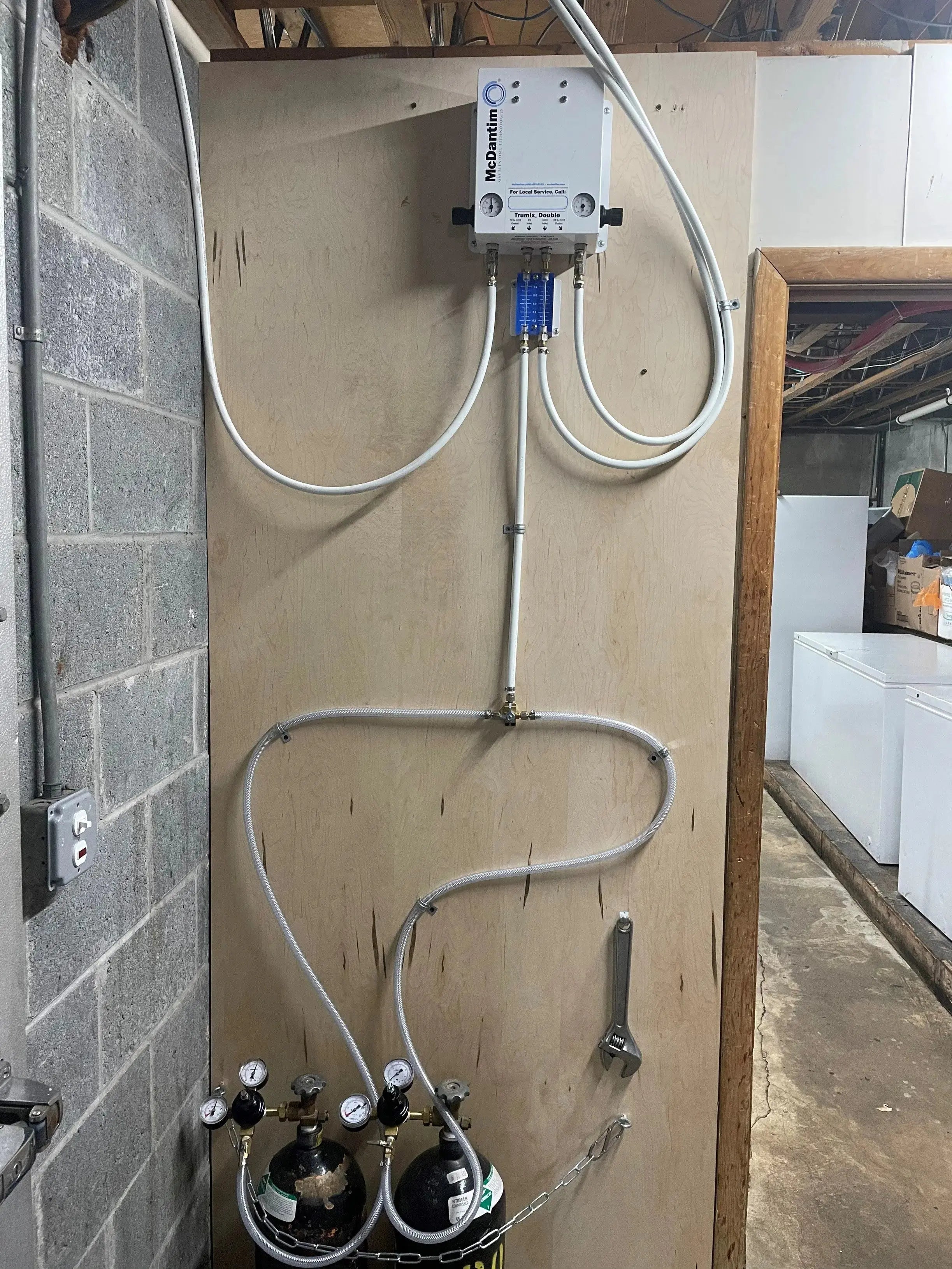
Mixes CO2 and nitrogen on demand to one set ratio with plus or minus 2% accuracy, across a 0.4 to 40 liters per minute flow range. Wall mounts in minutes.
Why a McDantim Trumix blender?
McDantim Trumix blenders are the standard a lot of draft techs trust for long draw work, and for good reason:
- Accuracy you can rely on. The blend holds to plus or minus 2% of full scale or better, so the ratio you set is the ratio your beer gets.
- A wide flow range. 0.4 to 40 liters per minute covers everything from a slow night to a packed bar pulling on many taps at once.
- Simple installation. The panel mounts on the wall and ties into your existing CO2 and nitrogen supply.
- Room to grow. Single, Double, and Triple models let you run one, two, or three different blends at the same time, so you can add nitro and high-carbonation styles without extra premix cylinders.
If you run more than one style that needs its own blend, the Double or Triple blender pays for the flexibility quickly.

Delivers two distinct CO2 and nitrogen blends at the same time, so you can serve nitro stouts and standard drafts off one gas setup.
Why pair the blender with an in-line leak detector?
A gas leak is the most expensive problem in a draft system because it is silent. A loose fitting or a worn washer bleeds CO2 and nitrogen around the clock, draining cylinders you are paying to refill and, worse, dropping system pressure so your beer pours badly. Most bars do not find out until the gas runs out far sooner than it should.
An in-line leak detector sits in the gas line and shows you at a glance whether gas is flowing when no beer is being poured. If the indicator moves while the taps are closed, you have a leak to find. It is a small, one-time cost that protects the much larger spend on gas, and it keeps your carefully set blend doing its job.
If you already have a blender installed, you can add a standalone in-line detector to your gas line:

Monitors your gas line so you can spot a leak instantly. A single in-line indicator is also available at a lower price for simpler setups.
Get the blender and leak detector in one unit
Buying a new blender? You can skip the separate part and get the detector already built in. McDantim now offers each Trumix blender with the inline leak detector attached, so you get precise gas blending and at-a-glance leak monitoring in a single wall-mounted unit. It is the simplest way to set up the system right the first time.

Precise CO2 and nitrogen blending with the inline leak detector already attached. Also available as a Double Blender ($1,593.24) and Triple Blender ($1,746.36) with the detector included.
Frequently asked questions
What is blended gas in a draft beer system?
Blended gas is a mix of CO2 and nitrogen used to dispense beer. CO2 carbonates the beer and nitrogen adds push pressure without over-carbonating, which is what long draw systems and nitro beers need.
Do I need a gas blender for a long draw system?
Yes, in almost all cases. Long draw systems need higher pressure than straight CO2 can supply without over-carbonating the beer. A blender mixes in nitrogen to give you the pressure and the correct carbonation at the same time.
Is a gas blender cheaper than premixed cylinders?
Over time, yes. A blender runs on standard CO2 and nitrogen cylinders, which cost much less than premixed gas, and it lets you change blends without changing cylinders. The savings on gas and reduced beer waste typically cover the blender quickly.
What blend should I use for nitro beer?
Nitro beers like Guinness are usually dispensed on roughly a 25% CO2 / 75% nitrogen blend, which gives the low carbonation and creamy cascade pour those beers are known for.
How do I know if my draft gas system is leaking?
Install an in-line leak detector. If the indicator shows gas flowing while all your taps are closed, you have a leak. Without one, most leaks go unnoticed until cylinders run out far sooner than expected.
Can I get a McDantim blender with the leak detector built in?
Yes. McDantim offers Single, Double, and Triple Trumix blenders with the inline leak detector already attached, so you get precise gas blending and leak monitoring in one unit instead of installing a separate part.
Related guides
- Prosecco on Draft: The Smarter Way to Run Sparkling Wine at Brunch
- What You Should Know About Planning a Beverage System
Build your blended gas setup the right way
McDantim Trumix blenders, in-line leak detectors, and the fittings to tie it all together, shipped fast to bars and breweries across North America.
Shop gas blenders →Expert advice and free technical support on every order.