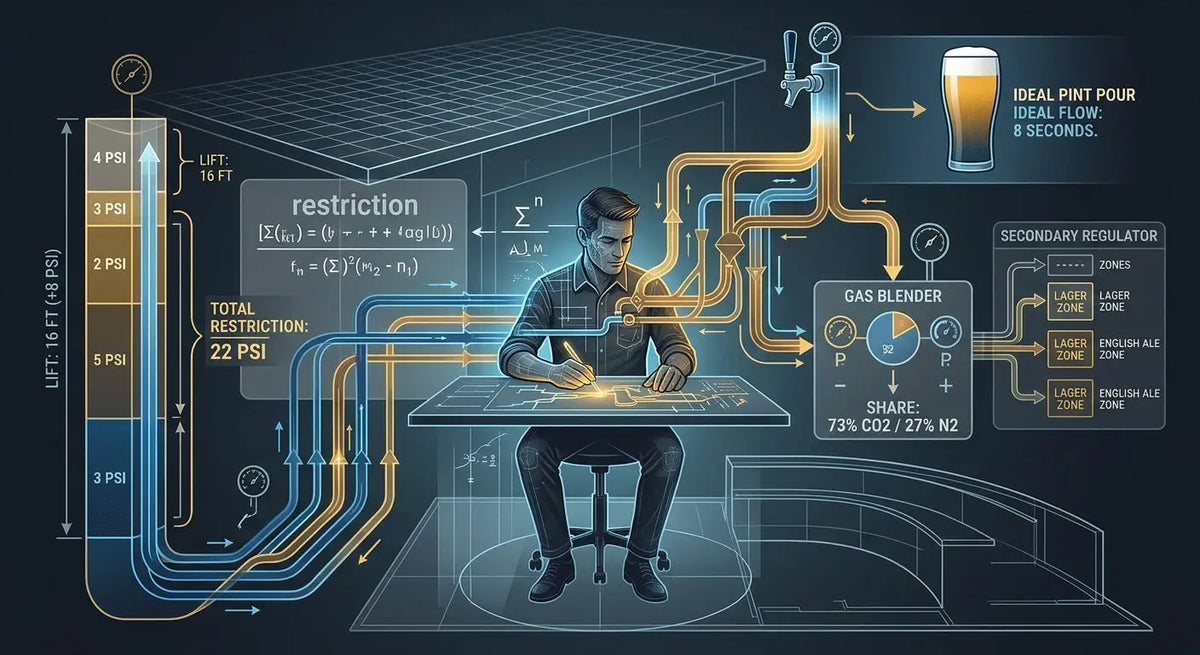
A long draw draft system is balanced when the pressure on the keg equals the total restriction between the keg and the faucet: line resistance, plus about 0.5 PSI for every foot the beer climbs, plus about 3 PSI for the tower shank and faucet. Set the CO2 pressure the beer needs first, make up the rest of the push with nitrogen through a gas blender, then fine-tune each tap at the tower. Get it right and every tap pours a pint in about 8 seconds with a clean head.
Most long draw foam calls aren't a bad faucet. The system was never balanced, or something changed (a new line, a moved tower, a different beer) and nobody re-ran the numbers. Here's the method in six steps.
In this article
- What do you need to balance a long draw system?
- Step 1: Get the beer cold and keep it cold
- Step 2: Find the CO2 pressure the beer needs
- Step 3: Add up the total restriction
- Step 4: Set the gas blend
- Step 5: Set a secondary regulator for each zone
- Step 6: Fine-tune each tap at the tower
- What do common long draw symptoms point to?
- FAQ
What do you need to balance a long draw system?
- The real installed route length and the vertical lift from keg to faucet
- The brewer's carbonation spec for each beer
- A gas blender and CO2 and nitrogen cylinders (available through your local gas supplier or beer distributor)
- Secondary regulators in the cooler
- A few feet of 3/16" vinyl beer line and flow control faucets for fine-tuning
- A pint glass and a stopwatch
Step 1: Get the beer cold and keep it cold
Every number below assumes the beer stays at 36 to 38°F from the keg to the faucet. On a long draw system that only happens with glycol running alongside the beer lines inside an insulated trunk line and up through the tower.
If the taps nearest the cooler pour clean and the far ones foam, or the foam gets worse as the night goes on, check the glycol before you touch a regulator. Our glycol chiller sizing guide covers the checks, and power packs are in our glycol chillers and long draw cooling collection.
Step 2: Find the CO2 pressure the beer needs
Start with the beer, not the plumbing. Brewers carbonate most beer to 2.2 to 2.8 volumes of CO2. To hold that level at 38°F, most ales and lagers need 10 to 15 PSI of CO2: a beer at 2.6 volumes needs about 12.4 PSI, one at 2.8 volumes about 14.5 PSI. Two quick adjustments:
- Temperature: every 2°F warmer adds about 1 PSI, every 2°F colder takes about 1 PSI off.
- Elevation: add about 1 PSI for every 2,000 feet above sea level.
Round up to the next whole number. The Brewers Association's Draught Beer Quality Manual has the full carbonation chart by temperature.
Write that number down. It doesn't change because the bar is 100 feet away. What changes is how much total pressure it takes to move the beer.
Step 3: Add up the total restriction
Total restriction is three numbers added together:
- Line: feet of line times the restriction per foot for that size.
- Lift: about 0.5 PSI for every foot the faucet sits above the keg.
- Parts: most fittings add almost nothing, but a tower shank and bent tube assembly adds about 3 PSI.
Kegs in series or a beer Y? Balance it as if there's one keg, measured from the keg that feeds the faucet.
| Line or lift | Approx. restriction | Typical use |
|---|---|---|
| 1/4" trunk line | 0.30 PSI per foot | Runs up to 50 ft |
| 5/16" trunk line | 0.10 PSI per foot | Runs of 50 to 120 ft |
| 3/8" trunk line | 0.06 PSI per foot | Runs of 120 to 300+ ft |
| 3/16" vinyl (choker) | About 3 PSI per foot | A foot or two at the tower |
| Tower shank and bent tube | About 3 PSI | Every glycol tower |
| Lift | 0.5 PSI per foot of rise | Basement cooler to first floor bar |
Worked example: a basement walk-in feeds a first floor bar through 110 feet of 5/16" trunk line, with the faucets 16 feet above the kegs.
- Line: 110 ft x 0.10 = 11 PSI
- Lift: 16 ft x 0.5 = 8 PSI
- Tower shank and bent tube: about 3 PSI
- Total: about 22 PSI
The beer only wants about 12 PSI of CO2. Push it with 22 PSI of straight CO2 and it absorbs extra gas. A few days later it's overcarbonated and foaming, someone turns the regulator down, and the far taps pour slow and flat. That loop is the most common long draw complaint we hear. For sizing the line itself, see our trunk line guide.
Step 4: Set the gas blend
Straight CO2 is being asked to do two jobs: hold carbonation and push beer. On a long run those need different pressures. Nitrogen barely dissolves in beer, so it adds push without adding carbonation.
Work out the CO2 share in absolute pressure (add 14.7 PSI at sea level to each gauge reading):
- CO2 the beer needs: 12 + 14.7 = 26.7
- Total system pressure: 22 + 14.7 = 36.7
- CO2 share: 26.7 / 36.7 = about 73% CO2 / 27% nitrogen
Longer runs and higher lifts push the CO2 share down. Many standard ale and lager long draw systems end up near 60% CO2 / 40% nitrogen, and nitro stouts run about 25% CO2 / 75% nitrogen. Straight nitrogen isn't the answer either: with no CO2 to hold carbonation, the end of a slow keg goes flat. Our blended gas guide covers why a blender beats premixed cylinders.

Runs two CO2/nitrogen blends at once from standard cylinders, so standard drafts and a nitro line each get their own ratio.
Step 5: Set a secondary regulator for each zone
The blender sets the mix. Secondary regulators in the cooler set the pressure for each group of kegs, so a high-carbonation lager and an English ale can run at different pressures off one blended supply. Plan one body per pressure zone, plus a spare if your tap list changes. Set each zone to its total system pressure from Step 3.

Three independently adjustable pressure zones from one gas line. 2 and 4 body versions are in the same collection.
Step 6: Fine-tune each tap at the tower
Pour a full pint on each tap and time it. You're aiming for about 8 seconds. The trunk line gets you close; the last few PSI are dialed in at the tower without pulling the bundle again.
- Choker line: a foot of 3/16" vinyl ($0.80/ft) between the trunk line and the shank adds about 3 PSI of restriction to one fast, foamy tap. Too slow after that? Trim it 6 inches at a time.
- Coiled line in the cooler: if the tower can't be opened up, add restriction in the walk-in instead. Coil extra beer line between two wall brackets, trunk line on one, keg jumper on the other.
- Flow control faucet: a lever on the faucet adds or removes restriction for the last pound or two. It won't fix a system that's badly out of balance.
Change one thing, pour, wait a few minutes, then change the next. Then pour every tap again after a week. A blend with too much CO2 shows up over days, not minutes.

Stainless forward sealing faucet with a flow control lever, so you can trim one tap without changing the whole zone.
What do common long draw symptoms point to?
| Symptom | Likely cause | Fix |
|---|---|---|
| Foam gets worse over several days | Too much CO2 in the blend | Lower the CO2 share, keep total pressure |
| Slow pour, faucet doesn't fill, beer swirls and breaks up | Over-restricted: too much restriction for the pressure | Check gas is on and set right, redo Step 3 |
| Fast pour, clean at the faucet but foams in the glass | Under-restricted on that line | Choker line, coiled line or flow control faucet |
| Pitchers alternate clear and foamy, worse when busy | Under-restricted: beer leaves faster than the keg refills the line | Add restriction, then recheck pressure |
| Far taps foam, near taps fine | Beer warming in the trunk line | Check glycol flow, chiller and jacket |
| All foam after a keg change | FOB not resetting or air in the line | Check that line's FOB detector |
Don't fix a restriction problem by cranking straight CO2. It works for an afternoon and overcarbonates the beer by the weekend. If a very long run still won't balance after sizing the line and blending the gas, it may need a beer pump. Call us before you buy one. More foam causes are in Fix Foamy Beer.
Frequently asked questions
What PSI should a long draw beer system run at?
It equals the system's total restriction: line resistance, plus about 0.5 PSI per foot of lift, plus about 3 PSI for the tower shank and faucet. Many long draw systems land in the 20s, which is why they run blended gas instead of straight CO2.
What gas blend should I use for a long draw system?
Divide the CO2 pressure the beer needs by the total system pressure, both with 14.7 PSI added at sea level. Many ale and lager long draw systems end up near 60% CO2 and 40% nitrogen. Nitro stouts run about 25% CO2 and 75% nitrogen.
Why does my long draw beer get foamier over a few days?
The beer is overcarbonating because the gas pushing it has more CO2 than the beer needs at that pressure. Lower the CO2 percentage on the blender and keep total pressure the same.
What is a choker line?
A short length of 3/16 inch vinyl beer line installed at the tower to add restriction to one tap. At about 3 PSI per foot, a foot or two calms a fast, foamy tap without changing pressure for the whole system.
Related guides
- The Complete Draft Beer Trunk Line Guide: Sizing, Insulation, and Glycol Setup
- Blended Gas for Draft Beer: Why You Need a McDantim Blender and Leak Detector
- Glycol Chiller Sizing Guide: 7 Checks for Long Draw Systems
Balance your long draw system the right way
Gas blenders, secondary regulators, trunk line and beer line, shipped fast to bars, breweries and the draft techs who keep them running.
Shop secondary regulators →Expert advice and free technical support on every order. Questions on a system that won't balance? Email info@wholesalebeerparts.com.