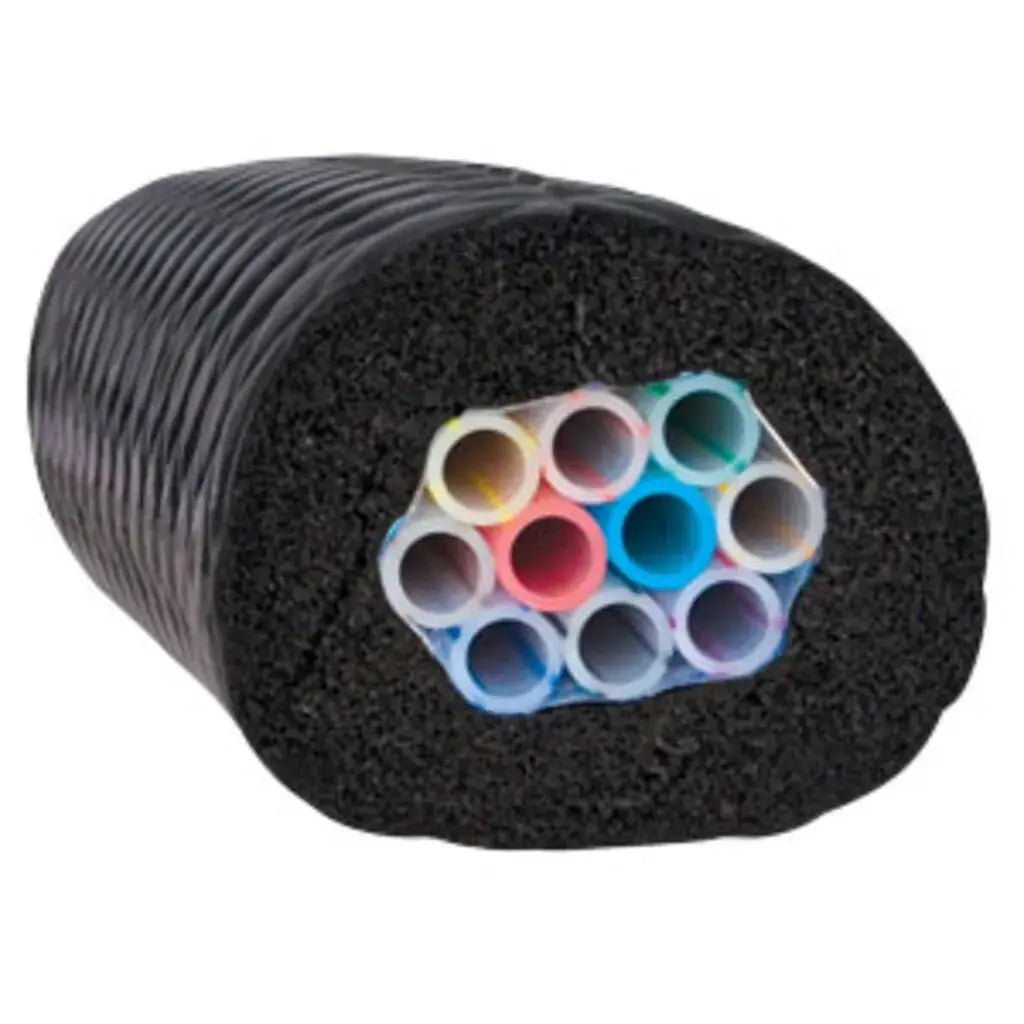
A draft beer trunk line, also called a python, is a factory-built bundle of beer lines, glycol supply and return lines, insulation, and a protective outer jacket that carries beer from the cooler to a remote tower. Getting three things right before you order determines whether a long draw system holds temperature and pours cleanly: the product line diameter, the number of beer and glycol lines in the bundle, and the insulation quality of the jacket itself. Get any of the three wrong and you end up with foam, warm beer, or a bundle that cannot be serviced once the walls are closed.
In this article
- What is a draft beer trunk line, and when do you need one
- How many product and glycol lines do you need
- How do you choose the trunk line diameter
- Standard trunk line vs flavor barrier trunk line
- Why does insulation and bundle construction matter
- What to map before you order
- Keeping glycol moving through the line
- FAQ
What is a draft beer trunk line, and when do you need one
A trunk line is not just a bundle of hoses taped together. It is a factory-built assembly of product lines, glycol supply and return lines, insulation, and a jacket, all engineered to move together as one unit from the cooler to the tower. Glycol circulates through the bundle in a closed loop next to the beer lines to protect temperature over distance, while the beer itself still needs correct gas pressure and total line resistance to pour properly. Most bar and restaurant installs need a trunk line once the run from keg to faucet passes about 15 to 20 feet, since that is roughly where an unchilled line starts warming the beer enough to cause foam. Stadiums, breweries, and multi-tap restaurants commonly run trunk lines 50 to 300 feet through conduit under floors or between buildings.
Micro Matic, the manufacturer behind the Barriermaster line featured throughout this guide, builds trunk line with exact-fit insulation, a foil layer, and a protective jacket specifically to hold beverage temperature and cut condensation. Their trunk line overview is a useful reference if you want to compare construction details across manufacturers.

How many product and glycol lines do you need
Start with the number of beverages you need at the remote tower, then add room for the layout you are actually building. A six-faucet bar needs six product lines; a 12-handle taproom needs 12. Count wine, cocktails, or non-alcoholic beverages too if they share the bundle. It is worth ordering one or two lines over your current tap count if you plan to add faucets later, since a spare line costs a lot less than re-pulling the whole bundle through conduit next year. Do not confuse the glycol lines with spare beer lines: they circulate coolant only, and the loop count depends on the product line count, the route, and the power pack design. Two glycol lines, a supply and a return, are standard up to about 8 to 10 product lines; larger bundles typically step up to 4 glycol lines to keep every tap evenly cold.

NSF 51 and FDA approved, foil heat barrier and 3/4 inch foam insulation, color coded lines for a fast install. Priced and cut per foot.

Micro Matic build, cut to length for a six-product, two-glycol-line configuration. Steps up from UBC's construction without changing diameter.
How do you choose the trunk line diameter
Trunk line diameter is chosen by run length, not by taste. A line that is too narrow for a long run creates enough resistance to slow the pour and cause foam; a line that is too wide for a short run pours too fast and flat. Use this table as a starting point, then fine tune once the system is dialed in:
| Beer line I.D. | Recommended run length | Approx. restriction | Best for |
|---|---|---|---|
| 1/4" | Up to 50 ft | About 0.30 lb/ft | Short back bar and single tap runs |
| 5/16" | 50 to 120 ft | About 0.10 lb/ft | Mid length long draw, cooler to bar |
| 3/8" | 120 to 300+ ft | About 0.06 lb/ft | Long draw, stadiums, high volume multi-tap |
Two kinds of resistance work against your keg pressure on a long draw system: static resistance from elevation change, which adds roughly half a pound for every foot the tower sits above the keg, and dynamic resistance from the beer line itself, which is what the table above controls. The goal is to land total resistance close to your keg's serving pressure, minus a pound or two for the faucet, so the pour balances at roughly a gallon a minute, or about 8 seconds to fill a pint. Once the trunk line diameter is set, installers fine tune the last few feet with a short length of narrow tower line, sometimes called a choker, rather than re-running the whole bundle. If you are between two sizes in the table, size up. A slightly larger line pours faster and is easier to balance with a flow control faucet than an undersized line that fights you at every pour. On very long or high volume runs, do not try to fix a restriction problem by raising CO2 pressure. Beer generally needs 2.2 to 2.8 volumes of CO2 (specialty styles can range wider), and pushing pressure past that to force flow through a too-small line will over-carbonate the beer. Long systems that still fight resistance after sizing up may need blended gas or a beer pump instead.

The least restriction per foot of the three diameters. Cut to length for a larger designed system with four glycol lines feeding twelve taps.
Standard trunk line vs flavor barrier trunk line
Standard insulated trunk line, like the UBC line above, handles most bar and restaurant installs without any compromise: NSF 51 and FDA approved tubing, a low adhesion interior that resists biofilm buildup, and enough insulation to hold temperature on typical runs. For breweries, high volume accounts, or any install where flavor carryover between different beverages in the same bundle is a real concern, a flavor barrier trunk line is worth the upgrade. Barriermaster Flavourlock tubing adds a co-extruded gas barrier layer built into the tube wall that cuts oxygen and CO2 permeation, so beer, wine, cocktails, and non-alcoholic pours can share a bundle without cross-contamination.
| Trunk line | Best for | Price |
|---|---|---|
| UBC 1/4" insulated trunk line | Standard bar and restaurant installs under 50 feet | From $12.60/ft |
| Barriermaster Flavourlock 1/4" or 3/8" ID | Larger bundles and long draw runs, 50 to 300+ feet | From $13.35/ft |
| Barriermaster Flavourlock 5/16" ID (Best overall for flavor protection) | Breweries and multi-beverage systems where flavor crossover matters | From $21.48/ft |

Made by Micro Matic with a co-extruded gas barrier layer that cuts oxygen and CO2 permeation, wrapped in the Black Diamond jacket for stronger insulation. Cut to order and non-returnable, so confirm your length before ordering.
Why does insulation and bundle construction matter
Cold beer in the cooler is only half the job. The bundle has to keep heat away from the product lines all the way to the tower. A properly built trunk line stacks several layers to do that: a foil heat barrier wrapped around the bundle to reflect ambient heat, foam insulation (typically 3/4 inch thick) creating an airtight, waterproof core, glycol supply and return lines circulating chilled coolant through the same bundle, and a rubberized outer jacket that resists tears and punctures during the pull through conduit. A damaged jacket, a crushed bundle, or an exposed section can make a correctly sized glycol chiller look like the problem when the insulation is actually at fault. That is why cheap knockoff assemblies are a poor place to save money, especially on a route that passes above a hot kitchen, through a ceiling chase, or near other equipment that adds heat.
If you are running individual lines through your own flexible duct instead of a pre-bundled trunk line, insulate the duct itself. A 1/2 inch wall foam sleeve over the duct cuts condensation and keeps the glycol-to-beer heat transfer working the way it should between the power pack and the trunk line.

1/2 inch wall foam tube that slips over flexible duct to cut condensation and hold cold between the power pack and the trunk line.
What to map before you order
Measure the real installed route from the cooler or power pack to the tower, not a straight-line guess. Include every turn, riser, ceiling path, and service loop, then mark where the bundle will be supported, where it passes through a wall or conduit, and how a technician will reach it later. A short straight-line measurement rarely matches the installed footage.
- Count every live and planned product line. Include wine, cocktails, or non-alcoholic beverages if they share the bundle.
- Record the furthest tower and any elevation change. The most remote faucet is usually the one that exposes a design issue first.
- Confirm the glycol loop and power pack capacity. Product count and loop design affect the cooling load.
- Plan gentle bends and protected penetrations. Avoid kinks, crush points, and a route that cannot be serviced.
- Add 15 to 20 percent to your measured length. Trunk line is cut to order and non-returnable, so it pays to measure twice.
Keeping glycol moving through the line
A trunk line only holds temperature if the glycol is actually circulating. If a chiller is running cold but the beer lines still come up warm at the tower, check the glycol pump inside the power pack first. A worn coupling or a failed motor stops circulation while the chiller itself keeps working fine. Listen for grinding or rattling from the power pack and check that the pump is actually moving glycol, not just that the chiller is cold.

Direct replacement for most standard glycol power packs, same flow rate and mounting. Ships within 1 business day; email us the model on your power pack if you are not sure it matches.
Related guides
- Glycol Chiller Sizing Guide: 7 Checks for Long Draw Systems
- Fix Foamy Beer: Causes and Fixes for Draft Systems
- What You Should Know About Planning a Beverage System
- How to Maintain Your Beer Lines Effectively
Frequently asked questions
What size trunk line do I need for a 50 foot run?
A 50 foot run sits right at the transition point most installers use: 1/4 inch I.D. line works up to about 50 feet, and 5/16 inch line takes over from there. At exactly 50 feet, 5/16 inch is the safer choice, especially if the system will need to feed more taps later without foaming.
What size trunk line should I use for runs over 100 feet?
Use 3/8 inch I.D. beer line for runs from about 120 feet up to 300 feet or more. It carries the least restriction per foot of the three common diameters, which keeps long draw pours from crawling.
How many glycol lines does a trunk line need?
Two glycol lines, a supply and a return, are standard and typically handle up to 8 beer lines in the same bundle. Larger bundles, generally 10 or more beer lines, commonly step up to 4 glycol lines so every tap stays evenly cold.
Why is my beer warm even though the glycol chiller is running?
A chiller that is cold does not guarantee the glycol is moving. A worn coupling or a failed pump motor inside the power pack stops circulation while the chiller itself keeps cooling normally, so warm beer with a cold chiller usually points to the pump, not the chiller.
Is a flavor barrier trunk line worth the extra cost?
For a single-brand bar pouring a handful of beers, standard NSF approved trunk line is usually enough. For breweries, high volume multi-tap accounts, or any system where flavor crossover between different beverages in one bundle is a real risk, a flavor barrier line like Barriermaster Flavourlock earns its higher per foot price.
Can draft beer trunk line be returned if I order the wrong length?
No. Trunk line featured in this guide is cut to order and priced per foot, so it is non-returnable once cut. Measure the installed route, add 15 to 20 percent for bends and routing, and confirm the length before you order.
Not sure which trunk line fits your system?
Send us your run length, tap count, and elevation change and we will confirm the right diameter, bundle count, and glycol setup before you order.
Shop draft beer trunk line →Free technical support on every order, cut to length and ready to ship.