

Description
Stay up to date on great deals and new products! Plus get 10% off your first order!
Sign up for our emails to get 10% off your first order. We'll also keep you updated on new products, exclusive collabs and promos.
By providing your email, you agree to receive recurring automated marketing emails from this shop.
Every unnecessary line cleaning costs you beer, chemicals, labor, and profit.
Draught Guard® puts an end to that.
This patented, non-chemical electronic draught line protection system works 24/7 to stop biofilm and beer stone before they ruin your beer—so you can clean less, dump less, and sell more perfect pints.
If you’re still cleaning every two weeks, you’re pouring money down the drain.
Traditional cleaning only reacts after contamination forms. Draught Guard prevents it from forming in the first place.
Using a proprietary low-frequency electronic signal that travels through the beer itself over 1,900 times per second, Draught Guard protects the entire line—from keg to tap—no matter the length.
No chemicals.
No magnets.
No gimmicks.
Just proven science.
Independently validated by top research institutions:
Up to 98% inhibition of biofilm formation
80–90% reduction in live biofilm cells
99% reduction of E. coli
The ONLY system to pass ASHRAE testing protocols
Translation?
Cleaner lines. Better beer. Fewer cleanings. More profit.
With Draught Guard, operators routinely:
Extend line cleanings from every 2 weeks to every 12 weeks
Slash beer dumped during cleanings
Reduce chemical usage and labor hours
Achieve ROI in as little as 6 months
Many locations save $8,000+ per year—and large venues save tens of thousands.
Treats up to 12 beer lines per unit
Works on any length system (short runs or 450+ ft trunk lines)
Compact, durable, NSF/UL/CSA approved
Simple install—mount anywhere along the trunk line
Runs on standard 110V power
Once it’s on, it works non-stop.
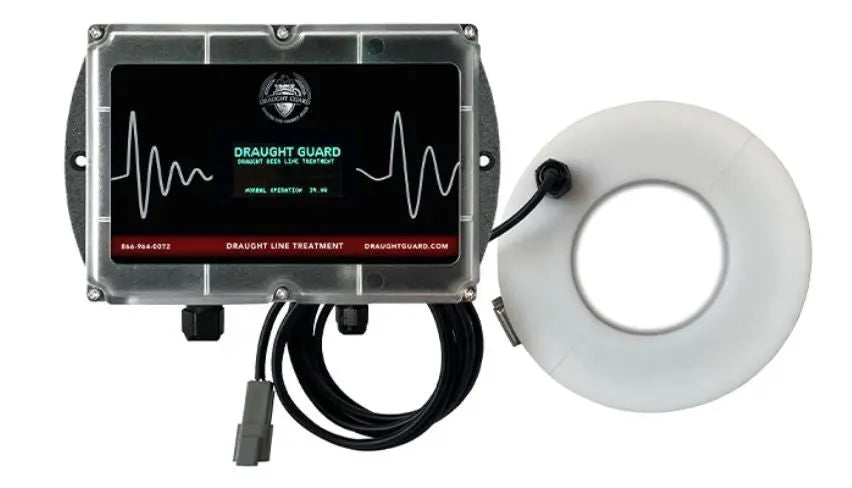
Draught Guard® main control unit
Signal transformer & treatment ring
Mounting hardware
User manual & warranty
Breweries protecting brand integrity
Bars & restaurants tired of dumping beer
Stadiums running hundreds of lines
Service companies selling higher-value draught solutions
Draught Guard doesn’t clean lines—it makes clean lines stay clean.
If you care about:
Beer quality
Profit margins
Reducing waste
Smarter draught system management
Draught Guard is not optional. It’s essential.
More information HERE
Quick shipping
Most orders ship in one business day
Satisfied or refunded
We will only sell quality parts
Top-notch support
Reach out with any questions or issues
Secure payments
Secure payment processing